Wednesday, December 30, 2020

The Grandfather of All the Loyalist Dykemans

The ancestry of Ouida Dykeman Siulinski (1905-1985), my Dutch Canadian grandmother, has clear roots in the Dyckman Loyalists of New York. She descended from the "Grandfather of All the Loyalist Dykemans", Garret Dyckman, who changed the original Dyckman surname to Dykeman presumably to appear less foreign in the English-dominated society of early New York. He was born on 4 Mar 1741 in White Plains, Westchester, New York. 

During the Dutch colonial era, the original Dyckmans (the ancestors of Garett) were merchants and farmers in the area called Washington Heights today in Manhattan. The area was named Nieuw Haarlem (New Haarlem), after the Dutch city of Haarlem, and was formally incorporated in 1660. Hard to imagine Manhattan as a strictly agricultural society. 

After the war, in 1783 Garret emigrated with his wife and family to the British Colony of Nova Scotia. Soon thereafter, on August 16, 1784, the Colony of New Brunswick was created by partition. On January 20, 1787, the Dykemans were granted Lot no. 9 containing 150 acres on Jemseg Creek, Parish of Waterborough, Queen's County, New Brunswick, where they settled to farm.

Yielding now to a document found in the Digital Collection at the New York Public Library, here is a brief summary of the Loyalist story:

In the American revolutionary war there were many in the then new-born Republic who either refrained from participating or took the loyalist side in the conflict. These were called “United Empire Loyalists,” for they clung to the unity of the empire and refused to ally themselves with their fellow-colonists in revolt. When the war was over, those who took up arms on the loyal side found themselves in a hopeless minority, loaded with obloquy and subjected to indignity at the hands of the victorious republicans. Rather than live under these humiliating conditions, some of the loyalists returned to England; but most of them, preferring voluntary expatriation in Western wilds to living in a country that had become independent through rebellion, sought new homes for themselves in Acadia and Canada.

Another part of the Loyalist story and of my own ancestry is the suffering after the war in the form of persecution and loss of property. I could not begin to imagine the extent of personal agony that so many of my Loyalist's ancestors endured. From the same library report in the Digital Collection, "many persons were banished and prohibited from returning to their homes. More than 12,000 left New York."

Dykeman homestead in Jemseg
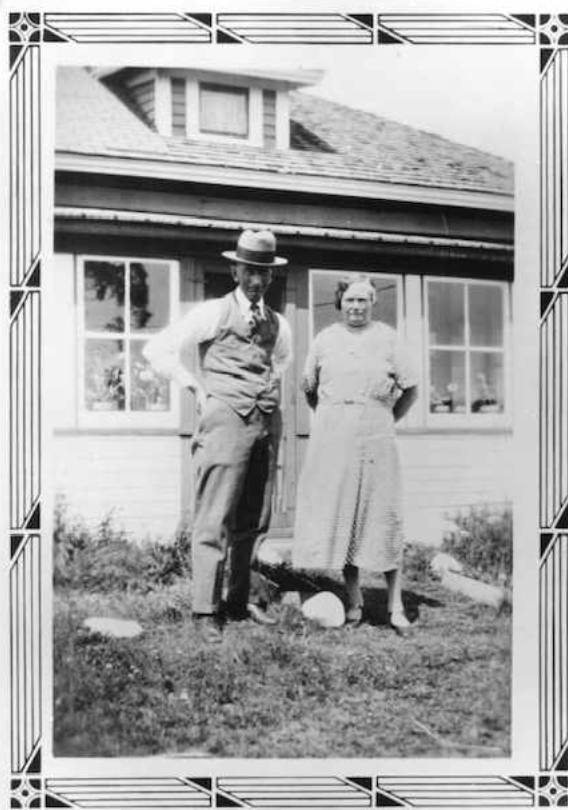
Joshua Reade Dykeman and Hattie Springer, 1935

After the hardship of relocation and resettlement, life surely improved for the future generations of those early Dykeman settlers. What I recall of my grandmother's descriptions of her family in Canada were happy stories and how close they all were. These strong bonds were experienced by my father as he often described the joy of spending his childhood summers on the family farm in Jemseg, New Brunswick. The photograph above shows the parents of my grandmother, Ouida Dykeman Siulinski, poising at the family homestead.

St. John Anglican Church, Gagetown, NB

Returning to our Loyalist grandfather, Garett Dykeman married Eunice Ann Hatfield at White Plains, New York. He died on 19 Jun 1813 and is buried in St. Johns Anglican Church Cemetery in Gagetown along with his wife.

Credits:
1. Kingsbridge image
2. Church image
3. Homestead image
4. Joshua Reade Dykeman and Hattie Springer image
5. Garett Dykeman United Empire Loyalist record 
6. Reasons for Migration of Loyalists Following American Revolution document
7. The area was named Nieuw Haarlem (New Haarlem), after the Dutch city of Haarlem, and was formally incorporated in 1660: Source
8. Following the Revolutionary War, in 1783 Garret emigrated with his wife and family to the British Colony of Nova Scotia. On April 20, 1784 they were granted Lot no. 66 in Parr Town (now Saint John, NB) etc: Source

Monday, January 28, 2019

Remembering the Artistic Talents of Jack


Jack at work as WGAN-TV cameraman
For the anniversary post of my Dad, Jack William Siulinski, who passed away six years ago today, I would like to honor the passion he had for his work and his love of photography.
Yesterday, I delivered a speech to a large audience of genealogists at the San Mateo County Genealogical Society in California. The speech was persuasive with a focus to promote blogging as an excellent platform to share and preserve the writing of one’s family history.

For this event, I opened my presentation in a different way. In preparing for this event, I came to recognize that my father and I shared similar passions; that of storytelling. He told stories with the images he created in his photography and film work. I tell stories through my writing with careful selection of images. Although, I don’t have the added talent that my Dad had for painting and drawing, I consider that when I am writing a blog post, I am working on a different kind of canvas. Here are three examples of the creative talents of my Dad's work:

Portland Headlight image taken from a small chartered plane
1963 Christmas Photo Card
A simple but beautiful drawing...

Jack's love of photography began before his formal training at the Rochester Institute of Technology where he received an Associate in Applied Science degree in 1953. That I know because I am in possession of his carefully created photo albums that document his military life from enlistment to discharge. He would learn the technical skills of the craft after his days in the Navy. Here are just a few of the photography tools that were used by my father back in the day:

The author posing for the artist
Part of the legacy Jack left to his family are numerous portraits that he took of us during our childhood.  He was precise in the framing of his subjects. I believe he really enjoyed the tangible aspect to the craft when he was able to physically create prints from the filmed images he took. His work for the studio involved countless assignments on the road to cover news stories and special events. He also filmed several TV commercials often using his children as subjects eager to see themselves on the big screen! My favorite event that he filmed was a whale watching excursion in Casco Bay in Portland which was made into a television program. 

Sunday, February 18, 2018

More Findings on the Szulinski's from Schenectady

The family that drew me to genealogy is becoming more and more known. Our Polish family tree is expanding! With the diligent assistance of fellow genealogist and friend, Michelle LePaule, some key documents have been found to further loosen the brick wall of the Szulinski's of Schenectady.  I have long known that Albin Szulinski and Bronislawa (Podorska) Szulinski were processed through Ellis Island in May 1901 and made Schenectady their new home.  The names of their ancestral villages were found on church records from their parish and from there we were able to find Bronislawa's baptismal record on microfilm from Salt Lake City.

And now, Albin's and Bronislawa's marriage record has been found. They were married in the administrative district town of Raciaz, about an hour's drive from Warsaw in 1890.
  
Albin and Bronislawa marriage record, 1890

From another record found, we have gained the knowledge that the Szulinskis had already started their family in Poland before embarking on their transatlantic journey.  Michelle found a baptismal record from 1892 of Wincenty Szulinski, presumably the couple's first son.  Sadly, Wincenty lived for only one year. 


The other brick wall that has existed for many years is to discover more about their only daughter, Genevieve Szulinski (1910-1931).  Again with the assistance and expertise of Michelle LePaule, I have learned that Genevieve had a son named Edmund Theodore Simondiski who we believe is still living. We tried to contact him but got no response. From obit records, we learned that Edmund's father remarried in 1938, moved to Massachusetts, and had a daughter named Charlotte. With no response from Edmund, we reached out to Charlotte who would be Edmund's half-sister.


Letter from Charlotte Hunt 
Back in the day, Charlotte married and moved to Minnesota. Michelle found her current address on a people search website.  I subsequently sent a handwritten letter and on December 24th, I received a nice Christmas gift; a very nice response letter from Charlotte. The first page of the letter is here to the left. In the letter, Charlotte tells that after Genevieve died, Edmund was taken care of by her grandmother. She also tells the cause of Genevieve's death as tuberculosis. 

My father and his brother knew so little of their father's family of origin in Schenectady. It is amazing to me that an entire family is being recreated through the work of genealogy and family history.

Monday, January 19, 2015

Finding Bronislawa's Ancestral Homeland

Source: Liberty Ellis Foundation
The primary goal of a research trip I made to Schenectady, NY, in 2013 was to discover the ancestral villages of my Polish great grandparents. The searching involved lots of leg work, including visits to churches, cemeteries, former residences and city government offices. The death records of my great grandparents obtained from the city hall did not provide the names of their ancestral villages. This fact caused me to visit one more parish office that hot summer weekend before driving back to Massachusetts. Ultimately, this visit tipped the balance between a limited finding and an exciting discovery.  Before I share that discovery, a little background will show the full circle of a passionate genealogist.  

Genealogy searches often begin with either a census record or a ships manifest; true in this case as well. Several years ago, through diligent research done at the California Genealogical Society and Library in Oakland, CA, and with the help of my friend and genealogy colleague, Jerry McGovern, I learned of the fourteen day Atlantic crossing of my paternal great grandparents, Bronislawa and Albin Szulinski (later anglicized to Bessie and Albert).  In Hamburg, Germany, they embarked on the Pretoria (shown above) destined for a new life in New York on May 5, 1901.  A little research on Polish history pointed to the likely reason for their trip.  The country was involved in an extended period of poverty in the 1890s which caused a mass emigration.  Bronislawa and Albin may have simply wanted to emigrate for a better life in America. Notice the one letter variation of the surnames (Szulinski and Siulinski).  The name change appears to have been brought about by my grandfather, Adam T. Siulinski, before or at the time of his Maine marriage in 1928.

1901 Pretoria's manifest listing the names of Bronislawa and Albin Szulinski
Source: Ancestry.com
Obtaining the records of immigrant ancestors after emigration is a far less complicated endeavor than obtaining records generations later. When I am able to make the ancestral trip to my familys Polish homeland, I will need to know exactly where to go.  Thus, I never gave up my quest to discover where Bronislawa and Albin came from in Poland.  Hearing my grandfather talk about his upbringing, I understood his family to have been devout Catholics, so I focused my research on the two Polish-connected Catholic churches in Schenectady: St. Adalberts and St. Marys.  The parish office at St. Adalberts provided the burial locations and causes of death for Albin and two of his sons, Walter and Joseph, but did not offer any information related to places of origin in Poland.

Thomas Adam Szulinski's baptismal record from St. Adalbert's parish records.
-name later changed to Adam T. Siulinski-
The other Catholic parish office I visited is where I struck gold in the form of a sacramental record.  St. Mary’s Church had since closed so it was a challenge to find the location of where the records were being stored.  After being rerouted a few times from one office to another, I found the right place and the right person to talk to.  Kudos to Debbie May at the Church of St. John the Evangelist who did the Szulinski lookups for me.  A few months after my Schenectady visit, an envelope arrived in my mailbox containing a copy of the sacramental record of my grandfather’s baptism (see image), and which happened to reveal the names of the ancestral villages of both Bronislawa and Albin (see image above).

Baptism record of Bronislawa (Podorski) Szulinski
Source: Salt Lake City Library microfilm.
Having discovered these Polish place names, I ordered birth and marriage microfilms from the Family History Library in Salt Lake City specific to the areas shown on the baptism.  A few weeks later, I was searching through rolls of microfilm trying to find the birth and marriage records of Bronislawa and Albin. So far, I have found Bronislawa’s birth record from 1870 (see above), and what a find that was. There is nothing more pleasing to a genealogist than finding original records.


Google map image of Kraszewo Czubaki, Polish ancestral homeland of Bronislawa (Podgorski) Szulinski showing the close proximity to Warsaw.  My grandfather had always said his family was from Warsaw.

All the time, travel, and effort were well worth acquiring the knowledge of my immigrant ancestors’ places of origin. I look forward to the day I will visit these towns in Poland.  When I do make the trip, I expect to be as fortunate as I was with Jacki and Stephanie, to meet more Szulinski family members.  Minimally though, I am certain to find more exciting discoveries!

Sunday, February 23, 2014

The "Gully" Alongside Sargent Street

Our former residence on Sargent Street and the "Gully" behind as it looks today
Growing up along the site of a long-gone canal (part of the larger Cumberland and Oxford Canal) in Westbrook led to a lot of play and exploration for the neighborhood kids.  Back in the day, our name for the canal was the "Gully" which today looks a lot drier, more green and not as deep.

My sister, Paula Lowell, has many memories of the "Gully":
I spent my life in that gully! I played in it all the time including winter but the fondest memories are with the Tarzan swings. They were soooo much fun. We used to dig for those old medicine bottles. Every house on Sargent Street had a slew of them in their windows. Some of us kids used to collect frogs from the ponds. I used to put frog's eggs in buckets and bring them home. Mom must have loved that! Lastly, the gully was a great shortcut to walk to Canal School and I did that so many times.
So, how and when did the canal come to be and what were its uses?  It wasn't long after the state of Maine became a state in 1820, that the State Legislature created a lottery to raise funds for the construction of the Cumberland and Oxford Canal.  

The Warren House in Westbrook
with remnants of the canal in the foreground
Irish laborers began construction in 1827 to what would become a hand-dug waterway 20 miles long, 34 feet wide and 4 feet deep to accommodate flat-bottomed boats pulled by horses.  It officially opened in 1832, and provided a means of transporting lumber and farm goods from the lakes region to the coast.  For example, farmers in Harrison could have their farm products be sold in Portland.  On the return trips, furniture and other manufactured goods were transported inland.  
The canal began at Sebago Lake near White’s Bridge, and followed the general course of the Presumpscot River through four towns ending up in what today is called Thompson Point in Portland.  The Westbrook portion of the canal used to run alongside Sargent Street cutting over from Spring Street before it ran parallel with Glenwood Street near the present sight of Canal School.  

Source:  Image taken from a copy at the Maine Historical Society
Literacy rights are held by the Baker Library at Harvard University 
The value of canal transportation declined with the advent of the railroads.  The canal served its purpose for nearly 40 years, and was even used once to transport a man to the House of Correction (see above).  The handwritten receipt comes from an account book of Dexter Brewer.  He was a toll collector at one of the many locks along the route.

Other sources:
A Guide to the Cumberland and Oxford Canal, a booklet by Ernest H. Knight
Article by Dr. Joel Eastman in the Sun Journal, May 14, 2003
Maine Memory Image of the Warren House


Sunday, May 5, 2013

Tribute for Cap't Jack - The 5 Qualities

Preface: This post and the previous two posts represent a reprinted version of the speech given on April 6, 2013 at  the service for Jack W. Siulinski. 

     There are five qualities, to speak of, that really defined my Dad. The first quality was his love for animals. You may know that he loved dogs and was devoted to our family dog, Buffy, even though he seemed to yell at her a lot. Buffy did have a mind of her own! Dad would befriend dogs out in public every chance he got. He also loved birds and horses, which he was able to enjoy in his final years. His favorite activity at the Veteran’s Home was, no doubt, the horseback riding they offered there.


     The second quality was his humor. Dad had a pervasive sense of humor throughout his life as Paula shared. Some examples of his humor from the interviews in 2007: He was asked about school life in Rochester to which he replied, “I lived in a dormitory with a bunch of other schmucks!” When asked if he had an original plan for the size of his family, he said that he wanted a basketball team (5 on a team). I reminded him that he had more than a basketball team, and he responded: “well, more or less; I had a spare.” 

     The next quality that defined my Dad was his love of nature and being outdoors. I am glad that his service is in the spring. He was definitely an outdoor enthusiast.The short list of his preferred active passions is tennis, skiing, boating, camping, and biking. He also loved to BBQ.

The fourth quality was his love of travel, and Dad did a fair share of it, especially with his kids living in so many places.  During the interviews, he gave a thumbs-up for cruises, and particularly the food on the cruises.  Did you know he also traveled to Hawaii and Europe?  The picture to the left was taken in Heidelberg, Germany in 1996.  Two of the most fascinating experiences he ever had was flying over the Aleutian Islands when he was in the Navy, and flying in a helicopter over "The Grand Canyon of the Pacific", Waimea Canyon, on Kauai's West Side with Mom in 1994.  It was great that he got to see this beautiful place. 

Waimea Canyon
http://www.kauai.name/kauais-waimea-canyon/
     
     The last quality and the one that defined Dad the most, for lack of a better word, was his sociability.  His social nature of connecting so easily with others was true in both his personal and work life.  As a child, I remember getting the impression that he was so important and well liked which made me feel important as well. 
     Dad's social skills never faltered even to his last days. The caretakers at the Veteran's Home in Scarborough, Maine, would often say they loved my Dad. When we would stroll along the halls and grounds, they would stop us to say hi, to whom they called Cap’t Jack, and sometimes gave him a hug.  I believe this quality of sociability got passed on to all of the Siulinski kids, and what I suspect is that it will also be highlighted in our services when our time is up.


Closing thoughtsHaving moved back to the east coast for a new job last fall, I was able to spend much time visiting my Dad during his last months. Speaking on behalf of my siblings: by being there for him, we were able to give back a little to the Dad who was always there for us.  No matter how different we were as kids and as adults, he always wanted us to be happy. During the family history interviews back in 2007, I asked my Dad how he would like to be remembered.  His response was: ”just being a nice guy..."
    
Click below to see a slideshow tribute:


Saturday, April 27, 2013

Tribute for Cap't Jack - Family and Career


     Jack’s career, his marriage, and the start of his family all began around the same time in the early 50’s.  When he got out of the service in 1950, he bought a new car and started taking courses at Portland Junior College - which later became USM.  It was his high school friend, Bud McCue that introduced Jack to Pauline.  How that came about: Pauline was living at Pine Point, and spending much time with her friend Sue Breton.  Since Bud and Sue were good friends, and Jack and Bud were hanging out again, one Sunday they drove out to Pine Point in his new car, and here is where Jack meets Pauline - this was the summer of 1950. Not to date my mother but 60 years ago she married Jack, and they moved to NY where he finished his 2nd year of college at RIT.  He graduated in 1952 and their first child was born in 1953.

Jack was a real photographic artist and film man.  He loved it so much that for many years we had a working darkroom in the cellar on Sargent Street.  Because photography was a passion not just a job, it extended to his family life, and therefore we have so many great pictures from throughout the years. The following images come from Jack's portfolio of photographic talents.  Since I wrote the speech, I get to show a baby pic.  I do not know how he got me in that pose or in those clothes!


     Dad was proud of his work.  After the interviews in 2007, he gave me reels of film that he had saved.  I am looking forward to getting them digitized at some point.  Probably, he was most proud of the work he did for the children at the Pine Tree Society.  I think he was also very proud of a special he filmed on whales that he really enjoyed doing.  If I was to choose his greatest film accomplishment, it would be the work he did on whales.

     One of my most positive childhood memories was going on work assignments with my Dad.  A few years ago, I wrote a journal entry about one those times.  I wrote:

It was great having a father as a photographer working in television. A couple of times I tagged along with him when he was assigned to film the governor at the State House. I remember entering the exclusive grounds of the oval office and being introduced to Governor Curtis sitting behind the big desk as my Dad began testing voice and lights. I had always viewed my Dad's work as special, and it having a coolness factor to it. This was one of those times.


     The Siulinski kids got to appear in local TV commercials and be a guest on the Lloyd Knight show.  In Dad's obituary, I wrote about the time I went on a plane ride in a 4 seater while he was filming the Prince of Fundy cruise liner for a TV commercial (see the image above).  What I did not say was I got so dizzy from that plane ride that I almost got sick.  When we finally landed, I felt like I was walking on the moon!  Still, it was a unique experience I will never forget.

Source: http://www.clker.com
Speaking of the moon, another distinct memory I have of something I did with my Dad was watching the 1969 moon landing live on the monitors in the CBS television studio in Portland.
In 1990, Jack retired after 27 years as a commercial photographer and camera operator for WGME-TV.