Showing posts with label Canada. Show all posts

Thursday, May 25, 2023

The Prince of Fundy: Maine to Nova Scotia

A distinct childhood memory when I was ten years old was when my Dad, Jack Siulinski, invited me to tag along with him on a work assignment. Jack was a commercial photographer who provided film for mostly local commercials and advertisements. More on the experience of being on the job with my Dad below.

Portland Headlight in the foreground

The Prince of Fundy was a 387 foot car, truck and passenger “cruise ferry”. It made daily trips from Portland, Maine to Yarmouth, Nova Scotia. The ship was operated by Lion Ferry AB of Halmstad, Sweden, and it’s crew and captains were mostly of Swedish origin. Lion Ferry operated similar cruise lines in Germany and Scandinavia. The tagline from a brochure from my Dad’s personal collection gives a compelling description: “The ocean ferry offering the excitement, luxury, and continental flare of an international cruise ship." The image to the left is from the personal collection of Jack Siulinski.

Photo advertisement
Life onboard included dining (including the staple Swedish Smorgasbord), dancing, shopping in the tax-free gift shop, and low stakes gambling (roulette, blackjack and slot machines). The round trip price was just $25 for an adult and $12.50 for a child. The charge for a vehicle was $32. One driver (passenger) was included in the vehicle charge. The saving of driving miles from Portland to Yarmouth was 858 miles. Passengers saved on time also; the one way voyage was ten hours. Today, the roundtrip cost of a car ferry from Bar Harbor, Maine to Yarmouth, NS is $210.

Back to my childhood experience on the job with my Dad: The assignment was for my Dad and I to board a small sport aircraft (a 4-seater similar to the image shown here) so that Dad could film the Prince of Fundy as it cruised out of Portland harbor into the Casco Bay Islands before heading out to the great Atlantic. This all sounded very exciting to a young child. Having never flown below, I was anxious what the experience would be like but I did not feel unsafe because I was with my Dad. 

Image Source: Pixabay
Once in flight the pilot putted along more or less in a straight-forward trajectory and soon were were several miles away from the coast. The view was spectacular but once we caught up with the Prince, the pilot started making these continuous swirling motions as the ship cruised along at full speed. I did not expect to experience a constant feeling of merry-go-round. With every turn, I began to feel dizzy. At first I kept the feeling to myself but when the dizziness turned to nausea, I told my Dad I was feeling sick. My suffering did not last too much longer as my Dad got the pictures he needed and we headed back to the landing strip. Was I happy to be on the ground! I remember telling my Dad that when I got off the plane, I felt like I was walking on the moon.

Fishing Boats in Yarmouth
Yarmouth, Nova Scotia is a port town located on the Bay of Fundy in south-western Nova Scotia, Canada. It lies at the Atlantic entrance to the Bay of Fundy, 210 miles by road west of Halifax. The site may well have been visited by Leif Eriksson the Lucky and his Norsemen around 1000 AD. The town of Yarmouth developed with the fishing industry and has a gorgeous heritage district filled with charming ex-sea captains' mansions with elaborately painted wood features, widow's walks and glass-walled turrets. 

During the heyday of the Prince of Fundy's operation, the service provided a boon to tourism in Maine and the Canadian Maritime Provinces. Today, there is no longer a ferry servicing Portland to Yarmouth but there is a high speed car ferry service from Bar Harbor to Yarmouth.

Referenced material and source citations: 
1. New York Times,  A New Car Ferry with a Difference, August 30, 1970: https://www.nytimes.com/1970/08/30/archives/a-new-car-ferry-with-a-difference.html
2. Source of Fishing Boats image: https://en.wikipedia.org/wiki/Scotia_Prince_Cruises
3. Press Release by Torben K. Anderson, Director of Marketing and Public Relations, Lion Ferry
4. Brochures and photographs from personal collection of Jack Siulinski
5. Source of paragraph about Yarmouth: https://tinyurl.com/y3zzvsaj

Wednesday, December 30, 2020

The Grandfather of All the Loyalist Dykemans

The ancestry of Ouida Dykeman Siulinski (1905-1985), my Dutch Canadian grandmother, has clear roots in the Dyckman Loyalists of New York. She descended from the "Grandfather of All the Loyalist Dykemans", Garret Dyckman, who changed the original Dyckman surname to Dykeman presumably to appear less foreign in the English-dominated society of early New York. He was born on 4 Mar 1741 in White Plains, Westchester, New York. 

During the Dutch colonial era, the original Dyckmans (the ancestors of Garett) were merchants and farmers in the area called Washington Heights today in Manhattan. The area was named Nieuw Haarlem (New Haarlem), after the Dutch city of Haarlem, and was formally incorporated in 1660. Hard to imagine Manhattan as a strictly agricultural society. 

After the war, in 1783 Garret emigrated with his wife and family to the British Colony of Nova Scotia. Soon thereafter, on August 16, 1784, the Colony of New Brunswick was created by partition. On January 20, 1787, the Dykemans were granted Lot no. 9 containing 150 acres on Jemseg Creek, Parish of Waterborough, Queen's County, New Brunswick, where they settled to farm.

Yielding now to a document found in the Digital Collection at the New York Public Library, here is a brief summary of the Loyalist story:

In the American revolutionary war there were many in the then new-born Republic who either refrained from participating or took the loyalist side in the conflict. These were called “United Empire Loyalists,” for they clung to the unity of the empire and refused to ally themselves with their fellow-colonists in revolt. When the war was over, those who took up arms on the loyal side found themselves in a hopeless minority, loaded with obloquy and subjected to indignity at the hands of the victorious republicans. Rather than live under these humiliating conditions, some of the loyalists returned to England; but most of them, preferring voluntary expatriation in Western wilds to living in a country that had become independent through rebellion, sought new homes for themselves in Acadia and Canada.

Another part of the Loyalist story and of my own ancestry is the suffering after the war in the form of persecution and loss of property. I could not begin to imagine the extent of personal agony that so many of my Loyalist's ancestors endured. From the same library report in the Digital Collection, "many persons were banished and prohibited from returning to their homes. More than 12,000 left New York."

Dykeman homestead in Jemseg
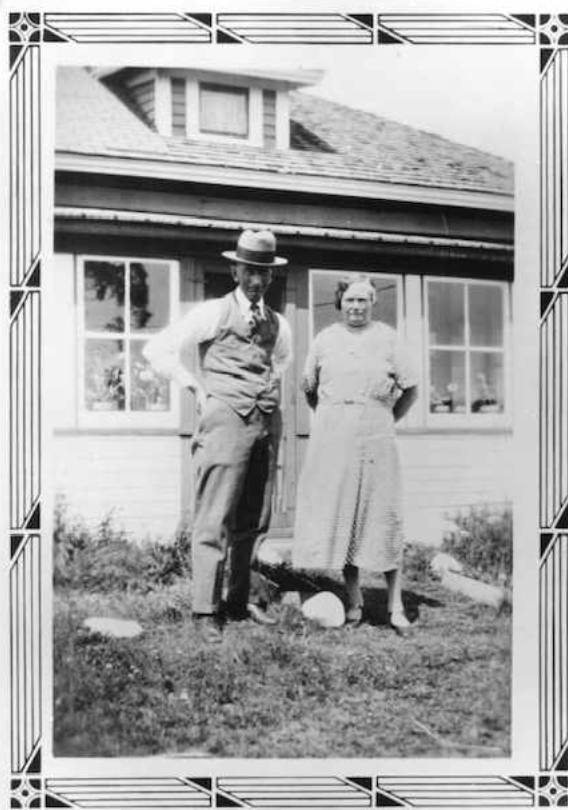
Joshua Reade Dykeman and Hattie Springer, 1935

After the hardship of relocation and resettlement, life surely improved for the future generations of those early Dykeman settlers. What I recall of my grandmother's descriptions of her family in Canada were happy stories and how close they all were. These strong bonds were experienced by my father as he often described the joy of spending his childhood summers on the family farm in Jemseg, New Brunswick. The photograph above shows the parents of my grandmother, Ouida Dykeman Siulinski, poising at the family homestead.

St. John Anglican Church, Gagetown, NB

Returning to our Loyalist grandfather, Garett Dykeman married Eunice Ann Hatfield at White Plains, New York. He died on 19 Jun 1813 and is buried in St. Johns Anglican Church Cemetery in Gagetown along with his wife.

Credits:
1. Kingsbridge image
2. Church image
3. Homestead image
4. Joshua Reade Dykeman and Hattie Springer image
5. Garett Dykeman United Empire Loyalist record 
6. Reasons for Migration of Loyalists Following American Revolution document
7. The area was named Nieuw Haarlem (New Haarlem), after the Dutch city of Haarlem, and was formally incorporated in 1660: Source
8. Following the Revolutionary War, in 1783 Garret emigrated with his wife and family to the British Colony of Nova Scotia. On April 20, 1784 they were granted Lot no. 66 in Parr Town (now Saint John, NB) etc: Source

Friday, April 12, 2013

Tribute for Cap't Jack - Early Life


Preface:  The next few blog posts are segments from the speech I delivered on April 6, 2013 to celebrate the life of my Dad, Jack William Siulinski.

     
     Good morning everyone. Thanks to everybody for coming especially to the family who flew in from all over the country. Today I will talk briefly about Jack's younger years, his life in the Navy, the start of his family, and his career. Then I will conclude with the 5 qualities that I think defined my Dad. I hope from hearing what I have to say that you will get the essence of who my father was...as a young person, as a brother, as a husband, as a family man, as a co-worker, and as a friend. 

     From interviewing my Dad for about 5 hours in 2007, I got to know him on a different level. He really provided me the motivation to research our family history. I wanted to know more about the family that he knew so little about on his father's side. The picture to the right is Jack's grandfather, Albert Szulinski, who lived in New York.

     One of the things I learned from the interviews was that Jack grew up in two very different environments:  the city life of Portland where he graduated from Deering High School, and the rural community of Jemseg, New Brunswick, Canada, where he spent many summers visiting his mother’s extended family.  One of Dad’s earliest memories was a long car ride to Canada where he distinctly remembered looking out a small window while his uncle drove the long, winding, dirt roads through the wilderness of Maine to get to Canada (see the map below).

Courtesy of google maps 
The Dykeman's of Jemseg had a farm with chickens, a few cows and a few horses. Their family dinners often had more than 20 people, a contrast to the small family life in Portland.
 
Jack's grandmother, Hattie Dykeman, always had homemade butter, bread and pies.  In talking with Dad’s brother, Adam, recently, the scent came back to him even today of the homemade butter and hot molasses over fresh bread. A fond memory of something Dad did with his grandfather, Joshua Dykeman, was getting up at 4:30 in the morning to go turn out the light in the lighthouse at Grand Lake.
The Siulinski’s of Portland were much loved by their Jemseg relatives, and the yearly visits were much anticipated. Only 5 years ago, in 2008, the Siulinski brothers, Jack and Adam, and their wives took a trip to visit the Canadian relatives for a family reunion in Saint John, New Brunswick, but did not visit Jemseg.  It was June of 1996 that Dad last visited the farm and the lighthouse on Grand Lake.


Before my Dad went into the Navy, he had six weeks of military training while still in high school at the Maine Maritime Academy in Castine. He referred to the transition from the academy to the Navy as “coming out of the frying pan and into the fire”.  What may have led Dad to choose to enlist in the Navy was seeing the fleet visiting Portland when World War II was still going on.

 
Source: wikipedia
Life in the Navy took Dad from the heat of the South Pacific to the frigid climate of Adak, Alaska. He entered the Navy in August 1946 as a Construction Electrician. In California, he attended a Radio and Communications school in the Seabees program. 

The next post will explore the marriage, family and career of Jack which all began in the early 1950's.  

Note: Some of the pictures in this post were provided by Adam and Jean Siulinski of South Portland, Maine, and Marilyn Currie of New Brunswick, Canada.