Saturday, December 31, 2011

Tidbits from the Interviews

On August 13, 2007, Jack and Pauline were interviewed at their home in Portland, Maine. Recently, I reviewed the transcripts from that interview and decided to share some tidbits of information from the conversation. The day of the interview culminated a series of recorded conversations about their lives.

Source:  Hurricane Ski Slope
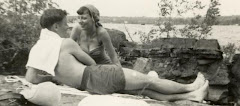
All of the answers provided below are paraphrased from Jack and Pauline reflecting on their lives. The pictures shown in the post relate to the answers.
Thinking it would be kind of fun, I have decided to use a quiz format. Sadly, there are no prizes to give away. Of course, the answers are located at the end of the post. 
So here we go…


1. Where did the Siulinski's almost move to?

2. Where did Jack and Pauline spend their summers in childhood?

3. What other occupation might Jack have chosen for a career?

4. What one value from Memere made an impression on Pauline?

5. What favorite places did Jack and Pauline name as having traveled?

6. In retirement, Jack had a part-time job. What was it?

7. What sport did the Siulinski family most enjoy together?

8. What location did Jack and Pauline take the family to for regular vacations?


The answers:

1.     Around 1960, while the family was living in Augusta, Maine, Jack pursued a work opportunity in Florida. The family came very close to relocating to Florida. The neighbors in Augusta actually hosted a going away party at a local hotel for Jack and Pauline where they accepted a gift; a silver bowl with "Westwood" engraved on it. Jack soon after decided not to take the job.

2. One of the most distinct memories of Jack's childhood was his many summer trips to the farming town of Jemseg, New Brunswick in Canada. Likewise, a vivid childhood memory of Pauline was summers spent at the family residence on Crescent Lake in Raymond, Maine.

3. Some of the training Jack had in the Navy was in the area of electronics so he thought he might have gone in the direction of being an electrician. As it turned out, he turned what was a hobby (photography) into a profession. Being paid for doing what you love is a great lesson in life. In my case, I am hoping to one-day turn my passion for oral histories and genealogy into a supporting income. 


4. Both her mother and her father influenced Pauline's faith in God.

5. For Jack, Hawaii and for Pauline, Niagara Falls (she was overwhelmed by the waterfalls). Jack also mentioned he liked going on cruises.

6. Jack worked for National Car Rental, driving cars from one location to another.

7. Skiing - it was the sport we all learned at a young age and practiced every season when Jack and Pauline purchased family passes. Our training mountain was Hurricane in Falmouth, Maine; no longer in operation but remembered by the Ski Museum of Maine. When then progressed to King Pine in New Hampshire which is still in operation. 


Source: I4BarHarbor
 
8. Bar Harbor was our rustic family getaway. 


Feel free to add any of your memories attached to these answers by adding a comment below or by sending an email.


Friday, October 14, 2011

The Dykeman Origins in Early New York

Jack’s maternal line (Dykeman) ascends from the earliest European families who chose to settle on Manhattan Island around the time the English wrestled control of the colony from the Dutch in 1664. Our immigrant ancestor, Jan Dykeman, journeyed across the Atlantic around 1666.


The image above shows the connection of Jack's mother, Ouida Dykeman to Jan Dyckman. Notice the difference in the surnames – this is caused by the turmoil of the American Revolution when a Loyalist faction of the Dykeman family moved to Canada to resettle on lands provided by the British government. 

Jan presumably came to the New World with very little, but became a prominent figure in the community. Arriving at a time that Dutch rule changed to English rule; he must have been involved in many impressionable and turbulent dealings. He married twice and was involved in numerous business transactions that led to him becoming a prosperous land owner in upper Manhattan (called New Harlem at the time) when he died in 1715.

Since the earliest European colonists to New York came from the Netherlands, the Dutch called the area New Netherlands. New Netherland consisted of settlements mainly along the Hudson, Delaware, and Connecticut Rivers, which today are parts of New York, New Jersey, Delaware, Pennsylvania and Connecticut.[1] 

-CLICK TO ENLARGE-
The name New Amsterdam was given to the growing Dutch village on the lower tip of Manhattan, and was a very diverse place both in terms of customs practiced and languages spoken.  Many of the original Dutch documents from the seventeenth century are currently being translated, transcribed and published through an ongoing project in Albany called the New Netherland Project and Institute

Thursday, September 30, 2010

Military Life post World War II

Jack's military life took him to far away remote places including the Mariana Islands (Guam) and the Aleutian Islands (Adak, Alaska). He entered the Navy in August 1946 as a Construction Electrition's Mate Second Class. He did his basic training in Bainbridge, Maryland, then went on what he called a "troop train" to California. At Port Hueneme in Ventura County, he attended a Radio and Communications school for twelve weeks (the Seabees program described in an earlier post) before boarding a ship for a five day cruise to Hawaii via San Francisco. Although in Hawaii for only one day, this provided enough time for checking out the beach and taking some pictures including the image below of Diamond Head on Oahu Island.
From here, he went on to his first major duty assignment that lasted almost two years - the 103rd NCB (Naval Construction Battalion) in Guam in the South Pacific. He lived in a tent for over a year then upgraded to a "quonset hut" shown below.

YEARLOCATIONASSIGNMENT
August 1946Bainbridge, MDBasic Training
Oct 1946Port Hueneme, CARadio and Communication School
Jan 1947Guam, Mariana Islands
103rd NCB
Duty Assignment 1
Apr 1949Adak, Aleutian IslandsDuty Assignment 2
July 1950Seattle, WADischarge
Picture of Diamond Head, Oahu, Hawaii taken by Jack in 1947

Even though Jack studied communications in the Port Hueneme training program, he ended up operating a power plant in Guam and later in Alaska as well. Besides the extreme heat, the living conditions in the South Pacific offered unusual and frequent visitors in and around the tents, in Jack's own words: rats the size of tomcats. Although, his service in Guam might have been considered a hardship, his experience in Alaska offered a contrast and clearly a different flavor.
Jack's second major duty assignment while serving in the Navy was in the Aleution Islands at the southern Bering Sea. He was assigned to Adak Island which sits on Kuluk Bay, 1,300 miles southwest of Anchorage on the lattitude of Vancouver Island in Canada. It has a population of 320.(source of stats: navy history). Jack may hold the distinction in the Siulinski family to have traveled to the area where man first walked onto the American continent via the Bering Land Bridge. Ages ago, much of the Earth's water supply was locked up in huge ice masses. Eventually the sea level fell exposing vast areas of land formerly under water. A continuous land bridge then stretched between Siberia and Alaska. Most archaeologists agree that it was across this Bering Land Bridge, also called Beringia, that humans first passed from Asia to populate the Americas. Source for the map: worldatlas
Source for the text describing the Bering Land Bridge: PBS
One of the most vivid images that Jack offered during numerous hours of being interviewed for his life story was when he flew over the Aleutian Islands.
"We flew practically to the end of the Aleutian chain.  We were flying a route above the mountaintops, you could see the craters of active mountains [volcanoes]."
Mt Edgecumbe outside of Sitka
Image source: AlaskaPride Blog
While serving in Alaska, possibly brought on by the elements and stress of work, Jack suffered a collapsed lung in June of 1950. While hospitalized in Alaska for diagnosis and observation, the Korean War flared up. He was sent to Seattle on a ship where he was then discharged on July 26, 1950j, and sent back to Maine on a train. Ironically and fortunately, the illness may have prevented a tour of dury in Korea. Unfortunately though, the July discharge in Seattle was processed just one month prior to Jack completing his full tour of duty. HE would later have problems re-enlisting into the Navy Reserves which he tried to do before meeting his future wife. This issue may have also effected Jack not receiving a full disability upon discharge which would have provided living benefits for him and his family during the time of convalescence. Although his condition was later deemed to be  "service-connected", he was only entitled to the medical benefits necessary to treat the condition. These facts made life difficult for a while but he persevered through the time of marriage and a new family. (source: Oct 1952 VA letter from personal archives of Jack Siulinski)

Although, Jack did not face combat in his service years, he did serve in the Navy during the time the time that the World War II Victory Medal was awarded to servicemen.
Endnote: Much of the material for this post was taken from a recorded interview with Jack in 2007. Also, many documents and pictures saved from his military days were used to create the story of his military life beginning in 1946 to the time period after his discharge and  when he met his wife in 1950.

Tuesday, August 31, 2010

The Szulinski Brothers of Schenectady

"The heritage of the past is the seed that brings forth the harvest of the future."
The above quote comes from the title page of a booklet called "Growing with Schenectady". It was prepared for the 1948 sesquicentennial of the city. If you, like me, have never seen this word before it means a one-hundred-and-fiftieth anniversary. The booklet told the development story of one of Schenectady's key industries: the American Locomotive Company (ALCO).
The photo shown here is a postcard image of the ALCO plant. This company along with General Electric served the world by their respective industries and my two great uncles contributed to the effort by devoting their life's work to these companies. Our immigrant ancestors were true die-hard industrialists.

My grandfather, Adam Siulinski, Sr., had two brothers. Their names were Joseph Szulinski and Walter Szulinski. Unfortunately, I do not have any photos of these two men but they lived their entire lives in Schenectady, and they were blue collar workers. The little information I found comes from newspaper articles I found on the FultonHistory website (these were articles orginally published in the Schenectady Gazette).  According to the articles, they both died in their fifties of unstated illnesses. Eventually I would like to find some living relatives, descendants or friends of these men who can speak about them from knowing them. Walter had a daughter, possibly adopted, and Joseph did not have any children.

Walter worked for General Electric for eighteen years in the Relations and Utilities Department until he became ill. Chris Hunter from the Schenectady Museum says that this department was probably located within GE’s Central Station Department, which was responsible for equipment sales, installation, and service to utilities. Walter was an Army veteran from World War II. Walter's passing in March 1959 garnered a full newspaper article in the Schenectady Gazette: "Szulinski Dies at 51; Was GE Employe". Notice the misspelling of "employee". The Gazette's copy editor was apparently on vacation. He was survived by his wife, Ann Olejnik Szulinski, and a daughter, Miss Patricia Ann Szulinski.

Image source: remaker.org
In the early 1880's, on a train trip from Albany to New York, Thomas Edison envisioned Schenectady as the perfect factory location for his new business that was to become General Electric. He liked the area because of its transportation, roads, railroads, and water. If anyone is interested to learn more about the history of General Electric, there is a comprehensive book available on the web called Men and Volts.


The 1923 Schenectady Directory has Joseph Szulinski working at General Electric. When he got married to Gladys Niegowski in 1945, the marriage announcement (Schenectady Gazette, 8-1-45) showed he worked for the Army Service Forces Depot as a "Packer". The Depot was a United States Department of the Army maintenance, distribution, and supply depot from 1941 through 1969. Mostly the depot shipped motor vehicles to the Port of New York. At its peak it employed four thousand people. Joseph died July 6, 1960 and is buried in the family plot at St. Mary's Cemetery.
Schenectady Gazette, Aug. 1, 1945
Source: fultonhistory.com
These men were common and hard working folks but the stories involving the companies they worked for were anything but common. Like the story of the first transcontinental truck delivery accomplished by five crew members of the ALCO company arriving at San Francisco City Hall on September 20, 1912. Their cargo was three tons of Parrot Brand Olive Silk Soap. It took them 91 days. Although, ALCO was known for building locomotives, they also made cars and trucks.


Thanks to Chris Hunter from the Schenectady Museum for providing research information for my post.
Sources for this post:
Army depot information: http://www.fsadva.com/ and http://dmna.state.ny.us/forts/fortsQ_S/schenectadyServiceForceDepot.htm
Photo of ALCO plant: http://web.me.com/gino.dicarlo/ginospage/TandS/Schenectady.html
Edison story information: http://www.schenectadyhistory.org/resources/mvgw/history/113.html

Wednesday, July 28, 2010

The Dyckman Coat of Arms

In May 2009, I attended a workshop on Heraldry at my local genealogy society (CGS). James Terzian was the speaker from the Heraldry Foundation. Here is a definition of the term taken from a websiteHeraldry is a system of identification of individuals and families based on hereditary devices (or "charges") centered on the shield. The whole idea of decorated arms and shields came about at the time of the crusades when societies were semi-literate so using images was very important. Richard I, "the Lion-Hearted", carried a shield emblazoned with three golden lions on a red background. Heraldry was made famous during the reign of Eleanor of Aquitaine in Northwest France where the display of arms was a common royal affair. She represented a rule incorporating the arts and troubadours offering plenty of opportunities to display these heraldic symbols in ceremonial fashion.

These events were referred to as tournaments and were used for training in the handling of weapons and horses, and evolved into a pageantry form in which the bearing of arms was a major part of the ceremony.  An excellent film from 1968, The Lion in Winter, gives a feel for the time period when knights and arms were the rage. To sum up, once used to identify knights on the battlefield (essential after the development of the closed helmut) then became known as a means to identify one's noble status, the practice of heraldry eventually became to be associated with anyone who had assets not just royalty.

Even Princess Diana has a coat of arms shown here.You can see other arms of the British royal family on the blog site where I source this image.

In regards to the DYCKMAN arms shown above, I asked Mr. Terzian what the symbols might mean. He thought they had an overall 'new world' meaning. The image of wheat could refer to wealth and the image of the shovel could refer to industry. I see the broken chain as possibly showing a freeing of some kind. Any other ideas?
Source of the Dyckman image above: The New York Genealogical and Biographical Record, Volume 34 , page 23.

Wednesday, June 30, 2010

The Famous Dyckmans

This is a story about one of the oldest Dutch families in New York City. The Dyckmans were one of those families and they prospered from farming and tending an apple orchard in a northern area of Manhattan now referred to as Inwood.     
Image source: Dyckman Farmhouse Museum brochure
Before the island became citified, farming was a thriving lifestyle for early colonists. The Dyckman’s made their livestock available to the markets of Lower Manhattan for many years. Here is a time period so far back. Try to imagine Manhattan three to four generations before the American Revolution. People in New York can do this by walking through the rooms of the Dyckman Farmhouse (built by William Dyckman c. 1784) and walking the grounds of the Dyckman homestead which is now a museum located in northern Manhattan. This home was featured in a Bob Vila televised special on the A&E network which I possess in VHS format. The Dyckman House has been an historic landmark since 1967.

Source of two house images: http://en.wikipedia.org/wiki/Dyckman_House
Of my four family lines, the ancestor's of my paternal grandmother (Ouida Dykeman Siulinski) heralds the most fame. The line is traced back to a man called Jan Dyckman who emigrated from Westphalia (an area in Germany) c. 1661. Our name spelling changed from Dyckman to Dykeman when a descendent of Jan, Garret Dykeman, moved his family and others to Canada in 1783. To show the link of my grandmother to the Dyckman line, the following images show the references of Ouida’s family in the book, Jan Dyckman and his Descendents. The images show the genealogy page (181) and the index page (187). Ouida (spelled "Weeda" in the book) is in the eighth generation.

A whole chapter in the Jan Dyckman book is devoted to Garret Dykeman, whose family and followers begin the Canadian line of the family. Garret’s marriage to Eunice Hatfield, niece of Capt’ Abraham Hatfield, begins his association with the Loyalists. The Loyalists (also known as Tories) were American colonists who remained loyal to the British monarchy during the American Revolution. When their cause was defeated, about 20% of the Loyalists fled or were driven out of the US to resettle in other parts of the British Empire (source: Wikipedia.org). There have been volumes written about the two sides which brought on the revolution but when it was all over, many losing-side colonists felt safer to pack it up and leave. Thousands of Loyalists boarded ships to Nova Scotia (what now consists of the provinces of New Brunswick and Nova Scotia). Land grants and other supports were offered to help in their resettlement but what they encountered in the new land was a more primitive and desolate landscape then what they had grown used to in America.

Map source: www.treasuredtimbers.com/rivers.html
Fortunately, Garret Dykeman’s group had chosen well. They decided to settle on the St. John River, a fertile area and further north were uplands which supported cattle raising (source: Jan Dyckman book, page 170). The place where he “set down his family” became Jemseg. This is the town of Ouida’s birth.
 
Ouida (Dykeman) Siulinski with sons, Jack and Adam, Jr.

End note: Research for this post came primarily from these two books:
Jan Dyckman and his Descendents by H. Dorothea Romer and Helen B. Hartman
Dutch New York: The Roots of Hudson Valley Culture edited by Roger Panetta.

Monday, May 31, 2010

Albin Szulinski Revealed

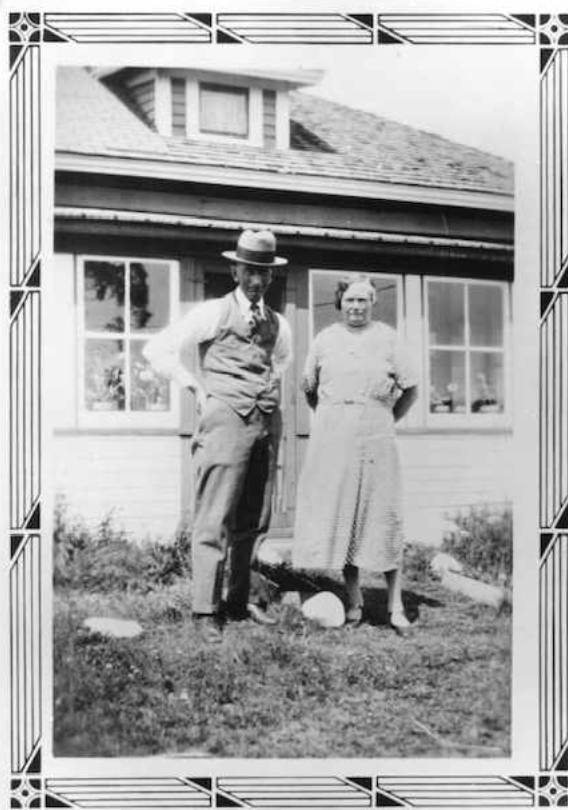
The odd title to this post comes from the impact that genealogy often provides: information not known about an ancestor is revealed through research and a bit of luck. The children of Adam Thomas Siulinski, Sr. (Jack and Adam, Jr.) did not get to know their grandparents, Bronislava (Bessie) and Albert (Albin) Szulinski. The name change and the son becoming separated from his family of origin presumably came about from Adam, Sr. marrying a woman of another faith from the family's traditional Catholic creed. Here is the only image I have of Albin Szulinski. It came from a photo album in the possession of Adam and Jean Siulinski who reside in South Portland, Maine.

Thanks to Beth Snyder from RAOGK for offering this obituary to help shed away the mystery of who Albin Szulinski really was:


Obituary April 13, 1943 Schenectady Gazette
Mass will be celebrated this morning at 9am in St. Adalbert's Church for Albin Szulinski, 70, retired, who died Saturday at his home, 1019 Second Ave, after an illness of about a week.  Burial will be in St. Mary's cemetery, McClellan St.  The A B Brzozowski funeral home, 644 Crane St., will be open this morning after 3:30pm. He was born in Poland and lived in this city about 50 years.  He worked at the American Locomotive Co. about 25 years and at one time was employed about 10 years at the GE Co.  He belonged to St. Josefa society 181, Z P R K.  He retired in 1931. Besides his wife, Mrs. Bronizlawa Podoraki Szulinski, he leaves three sons, Adam, Joseph and Walter Szulinski.There are three grandchildren.
Although, genealogists can provide factual information about an individual who lived many years ago, offering a sense of what their personality was really like is a challenging task indeed. Mr. Szulinski seemingly was a very traditional, conservative hard-working industrial worker from Schenectady, New York having immigrated from Poland around the turn of the century. Any child's fascination with locomotives might have its origins in the place Albin chose to work most of his life: the American Locomotive Company. Could Albin have worked a train as famous as the Nation's First Diesel-Electric Locomotive, Alco from 1924?
Source: THE SCHENECTADY DIGITAL HISTORY ARCHIVE - a service of the Schenectady County Public Library.